Copyright © TMS Global
TMS Global
PO Box 936559
Atlanta, GA 31193-6559
800.478.8963
Our EIN number or Taxpayer Identification Number is 58-1546441.

Name
Choose Password
Retype Password
“We didn’t come as missionaries to Spain,” John said.
During the COVID-19 pandemic, everybody was looking for a way out of Colombia.
Six families from one church found a pathway to Spain. One of them was John, an associate pastor who settled with his family in Antequera, a city in southern Spain.
“We left Colombia looking for work,” John told us during a break at this year’s Maclin Training, TMS Global’s two-week intercultural discipleship training. “We wanted a better quality of life, and better opportunities to raise our children.”
Like many Christians who relocate across borders, John was not thinking primarily about ministry. He was focused on caring for his family. Yet he also knew that following Jesus in Spain would create opportunities to share his faith. Once he arrived, he found himself facing a new question:
What does it mean to follow Jesus faithfully in a culture very different from your own?
John’s story is increasingly common. Across Spain, thousands of believers from Latin America are building new lives far from home. Many arrive seeking opportunities and stability. In the process, they also become cross-cultural witnesses in one of Europe’s most secular societies.
If you looked only at evangelical church growth statistics, you might conclude that Spain is gradually returning to its Christian roots. Look closer, however, and a different story emerges. Much of that growth has been fueled by immigrants from Latin America and elsewhere who have brought their faith with them.
Yet migration alone does not create gospel impact.
“The first thing Latinos look for is a church that’s just like theirs,” John said. “Where they sing the same songs, preach the same way, and belong to the same denomination.”
It’s understandable. Shared language, familiar worship, and cultural traditions provide comfort in an unfamiliar place.
But they can also become barriers to building relationships with the people God has placed around us.
“When you’re still in your home country and you think about going somewhere else, you say, ‘I’m going to help Spain come to Christ,’” John explained. “But when you arrive, it’s easier to gather with other Latinos. The mission changes, and you end up building a Latino church.”
John’s experience reflects a much larger shift taking place across the global Church. His story is not just about immigration. It’s about who is carrying the mission of God in the twenty-first century.
For generations, many Christians pictured missions flowing from the West to the rest. North American and European churches prayed, gave generously, and sent workers around the world. That legacy deserves our gratitude.
Today, however, the story is bigger.
The churches that earlier generations helped nurture are now sending disciple-makers of their own. As TMS Global President Jim Ramsay often says, mission is increasingly “from everywhere to everywhere.”
The future of missions is not one part of the Church reaching another. It’s the whole Church serving together.
But crossing borders does not automatically prepare someone to build relationships across cultures.
John says he wasn’t prepared for that challenge.
“We don’t receive training for cross-cultural witnessing when we are thinking about migration,” he said. “That’s why Maclin is so important. It equips and prepares people to do intercultural evangelism, moving beyond cultural forms and focusing on biblical principles.”
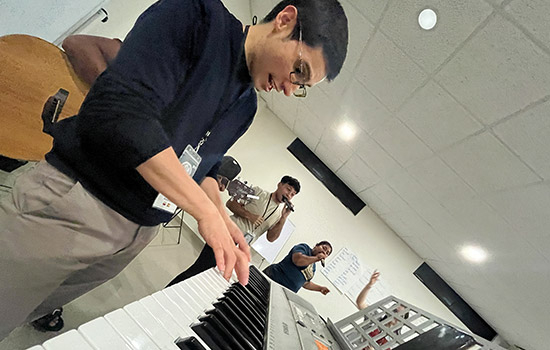
This year, more than 80 leaders from 20 countries gathered in Antequera for Maclin. The gathering was a living picture of the global Church, but its purpose went far beyond celebrating diversity. Participants learned to distinguish cultural preferences from biblical truth so they could build authentic relationships and share Christ faithfully across cultures.
As one of John’s colleagues, another Latino immigrant to Spain observed during the week, “Too often ministry begins with what we want to say. Cross-cultural discipleship starts by listening, serving, and understanding. Before asking, ‘How can I tell you about Jesus?’ we often need to ask, ‘How can I love you well?’”
For John, that meant moving beyond creating community primarily for fellow Colombians and intentionally building relationships with the Spanish neighbors God had already placed around him.
That is the kind of transformation TMS Global seeks to cultivate with your help. For decades, TMS has helped prepare Christians for cross-cultural ministry. Today, that same calling extends not only to those sent from North America, but to believers being sent from every part of the world.
What previous generations hoped for, we are beginning to witness—and faithful women and men like you have helped make it possible.
Copyright © TMS Global
TMS Global
PO Box 936559
Atlanta, GA 31193-6559
800.478.8963
Our EIN number or Taxpayer Identification Number is 58-1546441.